"The air is like a butterfly
With frail blue wings.
The happy earth looks at the sky
And sings."
- Joyce Kilmer, Spring |
|
|
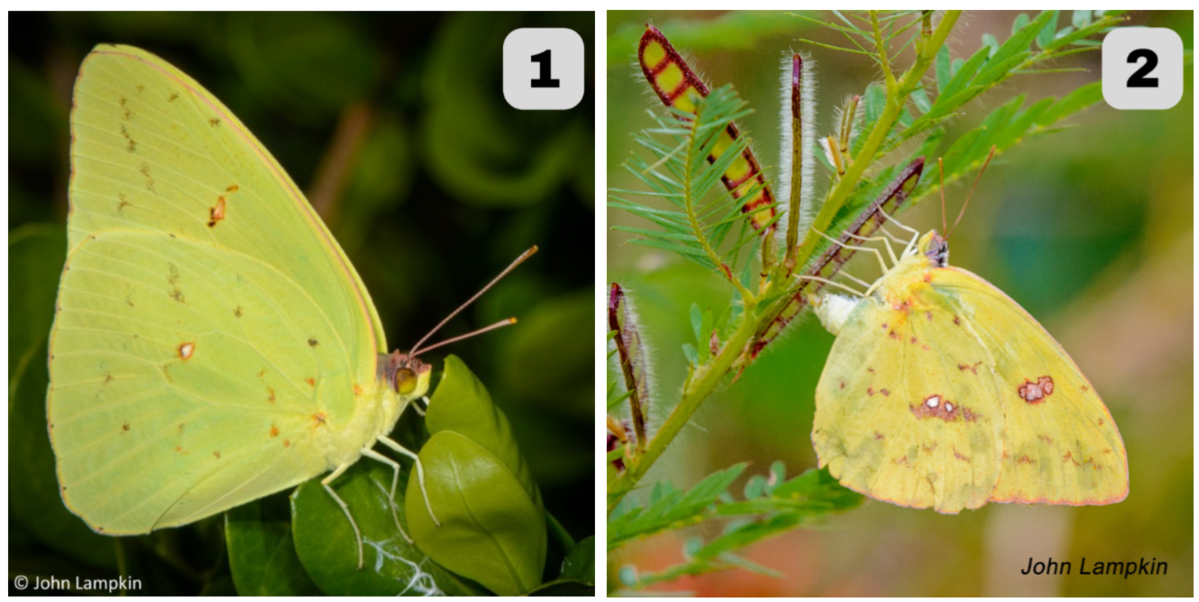
| | This month, our Butterfly of the Month is the Cloudless Sulphur. This beautiful butterfly is typically a lemony-yellow (some females may appear to be almost white) with an underside that may be marked with tiny reddish-brown flecks. (See Photos #1 male and #2 female.) The female is ovipositing in image #2, which basically means, laying an egg. With a wingspan of 2 1/4 - 3 1/8 inches, this butterfly flies year-round in Florida and prefers open areas such as farms, gardens, and roadsides. There are at least three generations in Florida, with some butterflies migrating north in summer months. As fall approaches, southern migrations are notable, with millions making the trip, flying as fast as 12 miles per day. Cloudless sulphurs lay single, slender, white spindle-shaped eggs that turn to yellow and then orange on host plants in the pea family. (Hosts in our area include Partridge pea (Chamaecrista fasciculata), Sensitive pea (Chamaecrista nictitans), Privet cassia (Senna ligustrina), and Bahama Cassia (Senna mexicana var. chapmanii).) Caterpillars that chiefly feed on flowers will appear yellow with blackish blue bands and dark spines; those that eat mostly leaves will be green with a yellow stripe and blue patches with less conspicuous spines.
(Interestingly, research indicates that certain host plants have extrafloral nectaries, which are glands that produce nectar outside the flower. The nectar produced by the glands attract ants, which helps protect the plant from caterpillar herbivory. (See more here.))
Cloudless sulphurs are especially common in our area and are regularly seen at Little Red Wagon Native Nursery, USF’s Tampa campus, Eckerd College in St. Petersburg, Picnic Island and many other locations in Hillsborough and Pinellas counties. Have you seen any recently? Why not let us know? Tag us on Facebook, Instagram, or Twitter and tell us where and when you saw them. |
|
|
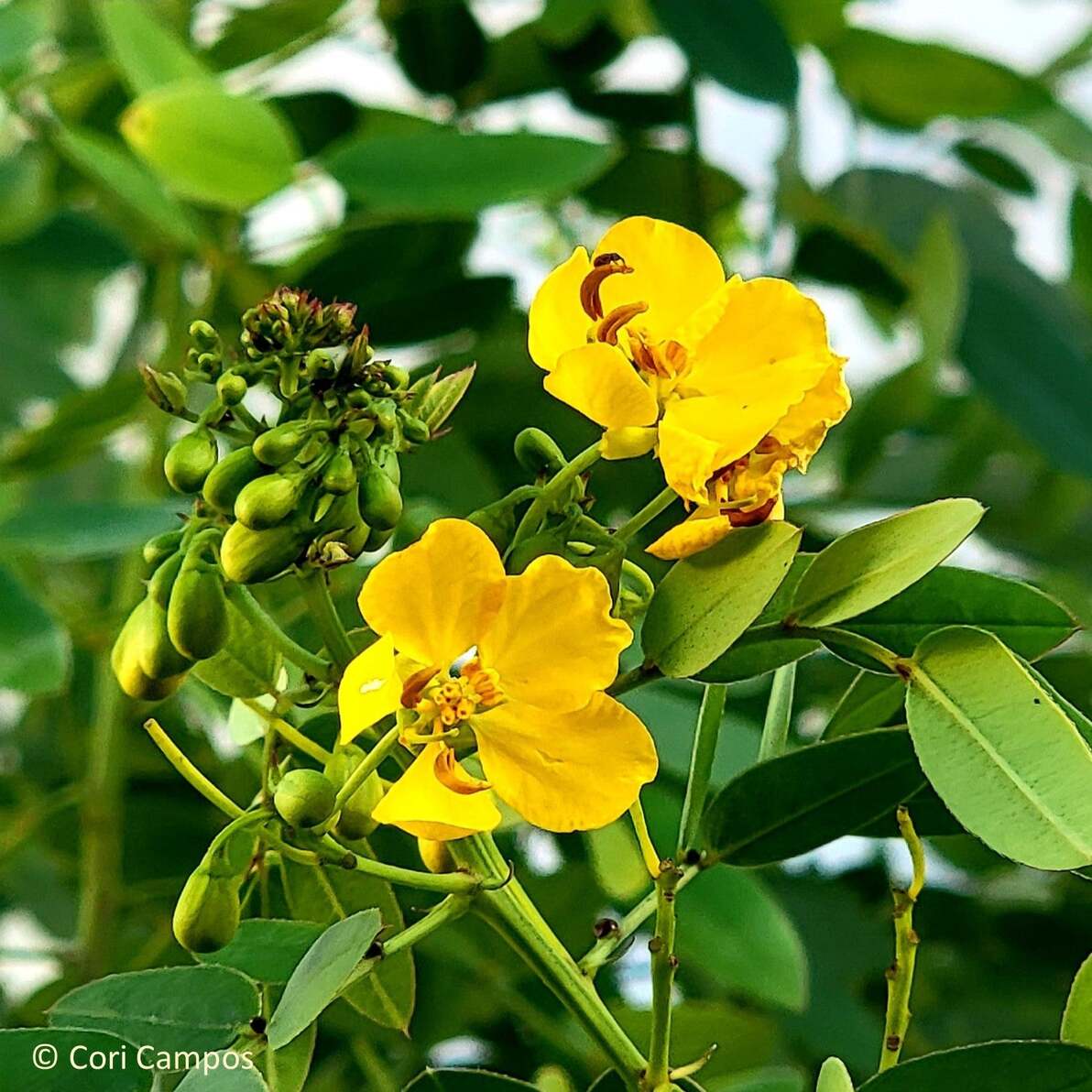
| | Bahama senna (Senna mexicana var. chapmanii) is a short-lived evergreen shrub that is native to the pine rocklands and hammock edges of extreme south Florida. With stalked clusters of buttery-yellow, five-petaled flowers, this legume is a statement piece that will typically grow to 4 feet or more with a spread that can be much wider than its height. The plant thrives in nutrient-poor limestone soils and full sun. It is moderately drought-tolerant and is suited to gardens in USDA Zones 10-11. South Tampa and much of Pinellas county is zone 10A. Like other sennas, Bahama cassia is the food source for Cloudless sulphur, Sleepy orange, and Orange-barred sulphur caterpillars. The plant is also a great nectar source for numerous species of bees and butterflies. Butterflies that seek out Bahama senna include Sleepy orange, Little yellow, Cloudless sulphur, Orange-barred sulphur, and Statira sulphur. This plant pairs well with other legumes, including Partridge pea (Chamaecrista fasciculata), Sensitive pea (Chamaecrista nictitans) and Sunshine mimosa (Mimosa strigillosa). Please note: This native is listed as a threatened species in Florida due to its limited range. Additionally, the similar-looking non-native butterfly senna (Senna pendula), which is sold at various big-box stores as a plant appropriate for butterfly gardens, has been identified by the Florida Exotic Pest Plant Council as a Category I invasive species that is altering our native plant communities. Please #NurtureNative and plant the original! | | |
|
|
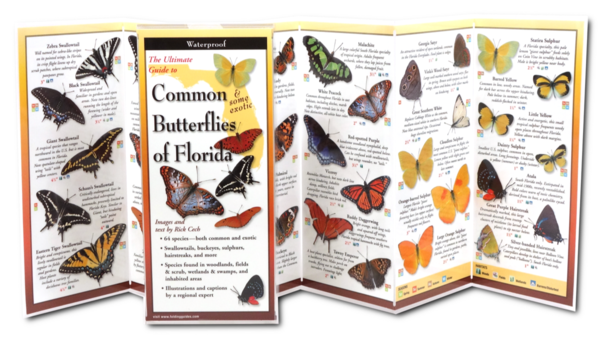
| | Spring is here! It's time to get outside and enjoy the great weather. These folding guides from Earth Sky & Water will help you identify the beautiful nature around us. Laminated reference guides are indestructible, waterproof, and provide instant access to what you want to know. Written and illustrated by local experts, these guides are perfect for the backpack, backyard, or the glove compartment. “Butterflies”, “Common Wildflowers”, and “Backyard Birds” are just a few of the titles available. Stop in our gift shop to see the full selection and be sure to join us on one of our Butterfly Walks this month. | |
|
|
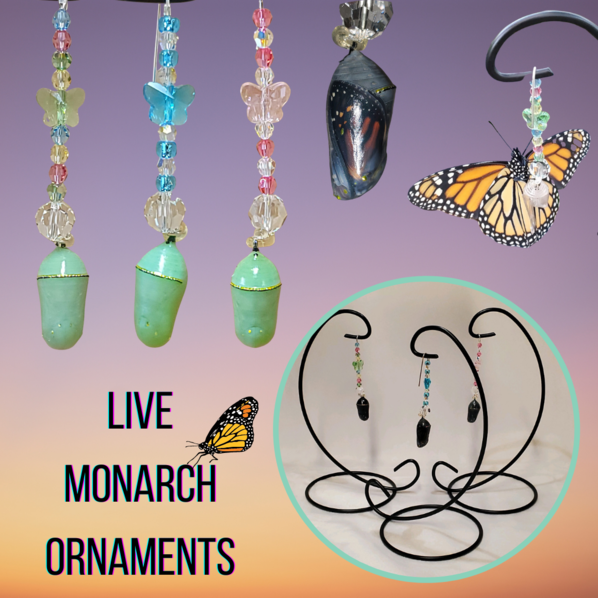
| | Live Monarch ornaments for Mother’s day. Pre-order a live monarch butterfly ornament jeweled gift for the wonderful Mom’s in your life. Each crystal ornament has a live monarch chrysalis attached (anticipated emergence/hatching date will also be provided). All of these monarchs are raised with the utmost care by a premier Butterfly Breeder to ensure they are healthy. (Ornament stand included). Each monarch comes in a gold gift box with instructions included. Hang the monarch ornament and wait. The chrysalis color will change from green to clear showing the monarch’s colors of orange and black the night before it will emerge or early the morning of emergence. Let the monarch dry for 4-6 hours and release outside during the warmest part of the day in a sunny location. We are accepting pre-orders now. Pick up of the ornaments will be Thursday May 5th through Saturday May 7th. Ornament bead color will vary. $25 each. | |
|
|
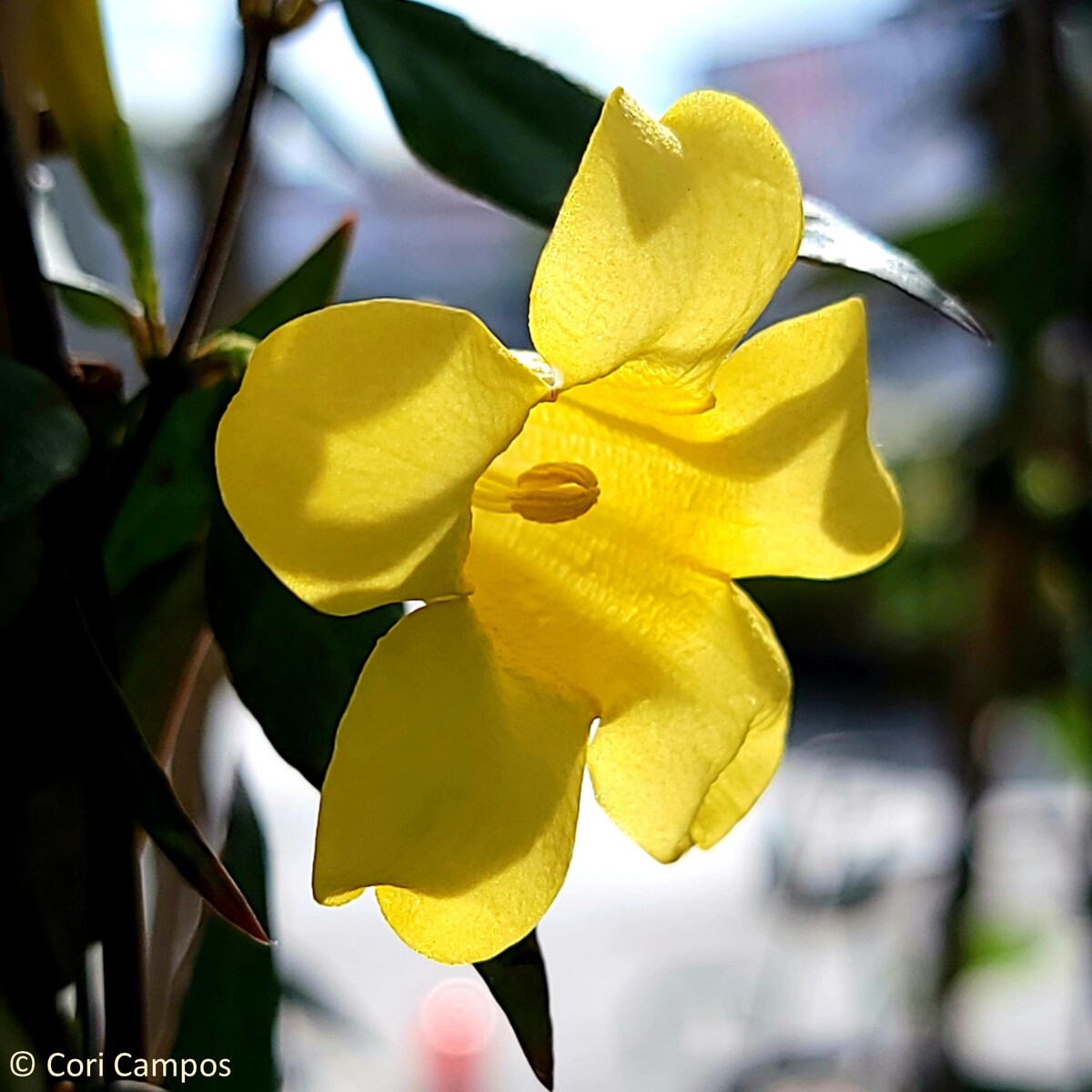
| | Carolina jasmine (Gelsemium sempervirens) is a twining, evergreen vine that grows up to 20 feet and can be trained to climb arbors, trellises, fences and other upright structures. Native to hardwood forests and upland mixed forests from Virginia and Florida west to Arkansas and eastern Texas and south to Guatemala, this vine is especially known for its beautifully fragrant canary-yellow trumpet-shaped flowers that typically appear in our area in late January or early February. For us, the appearance of its blooms acts as one of nature’s signals that winter is drawing to a close.
With value to wildlife that ranges from cover to sustenance, Carolina jasmine provides high value to wildlife. Its nectar attracts hummingbirds, bees, and butterflies. Warblers, cardinals, thrashers and other birds eat its fruit.
Carolina jasmine thrives in full sun and is deer resistant. The plant prefers well-drained, acidic soil pH that is regularly moist but it can tolerate neutral and alkaline soil pH and occasional flooding and occasionally dry soil conditions.
Please note: All parts of this plant contain toxic strychnine-related alkaloids and the plant is highly poisonous to humans. It is also extremely flammable. Consequently, please keep the plant away from children and plant it outside the defensible space of your home. | | |
|
|
| Nectar Plant of the Month |
|
|
(Editor’s note: This is a modified version of a blog which we originally posted last March. We thought it worth reprinting here.)
Thirty-one years ago this month, Florida’s legislature passed a bill that designated Coreopsis, a genus of flowering plants in the Aster family, Florida’s official wildflower. With 16 species native to the state (and at least one found in every county), these beautiful flowers are also used extensively in Florida’s roadside plantings as part of the Florida Department of Transportation’s Wildflower Program.
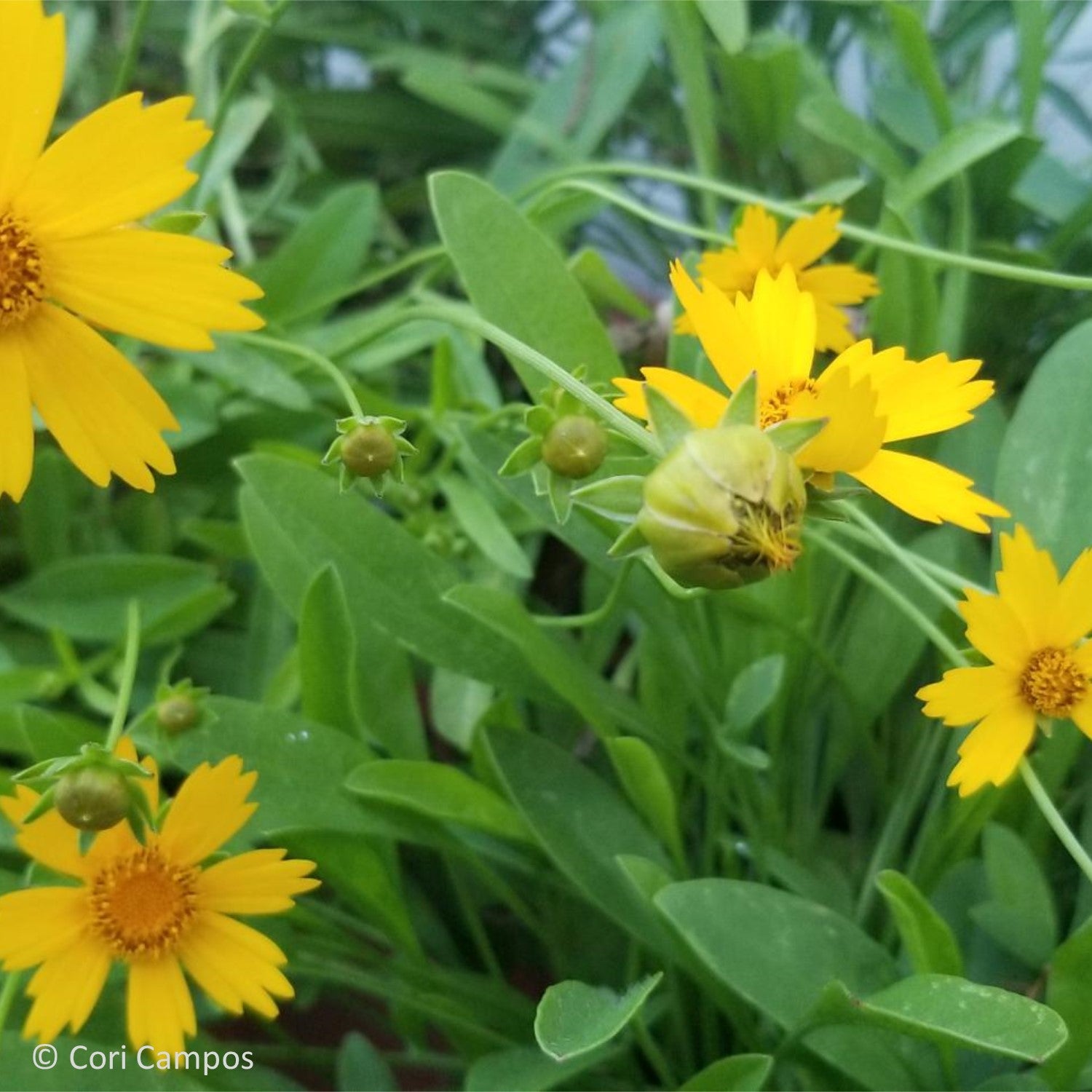
Here, in Tampa, we’re lucky enough to have three indigenous species. They are: - Florida tickseed (Coreopsis floridana), a 2-4 foot tall wetland species that blooms in the fall and winter;
- Coastalplain tickseed (Coreopsis gladiata ), a 2-foot tall species that likes moist soils and blooms in the fall;
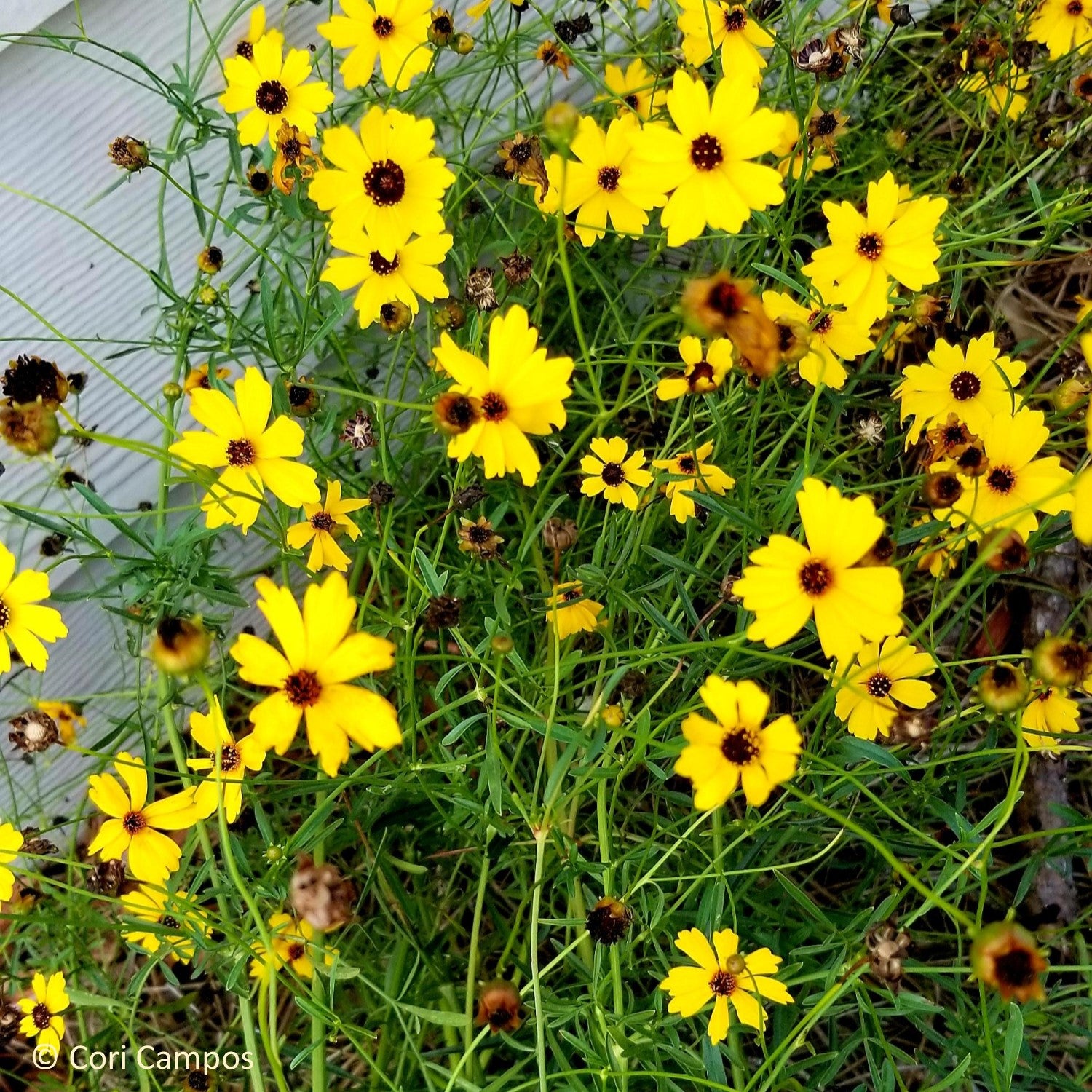
- Leavenworth’s tickseed(Coreopsis leavenworthii), a 1.5-3 foot tall species that likes mesic soils and begins blooming in early spring.
All three species have wonderful, daisy-like yellow blossoms that make me smile. More importantly, though, they also provide extremely valuable ecosystem services. Coreopsis is an important food source for the caterpillars of five moths–the Sunflower Bud Moth, Dimorphic Gray, Sunflower Moth, Common Tan Wave, and Southern Emerald. Audubon notes that in our area, the plant’s seeds may attract a whole range of birds including Cardinals and Grosbeaks, Chickadees and Titmice, Crows and Jays, Finches, Nuthatches, Sparrows, and Woodpeckers. Finally, the Florida Native Plant Society reports that Coreopsis species are an important nectar and pollen source for butterflies, bees, and other pollinators.
The Old Farmer’s Almanac notes the symbolic meaning of Coreopsis is “Always Cheerful.” Since these flowers can be a wonderful asset to almost any type of garden if you select the right species for your soil conditions, why not add some more cheer to your world? Plant some Coreopsis and help #NurtureNative. We have lots of species from which to choose, so stop by and we’ll help you pick some suited to your garden. |
|
|
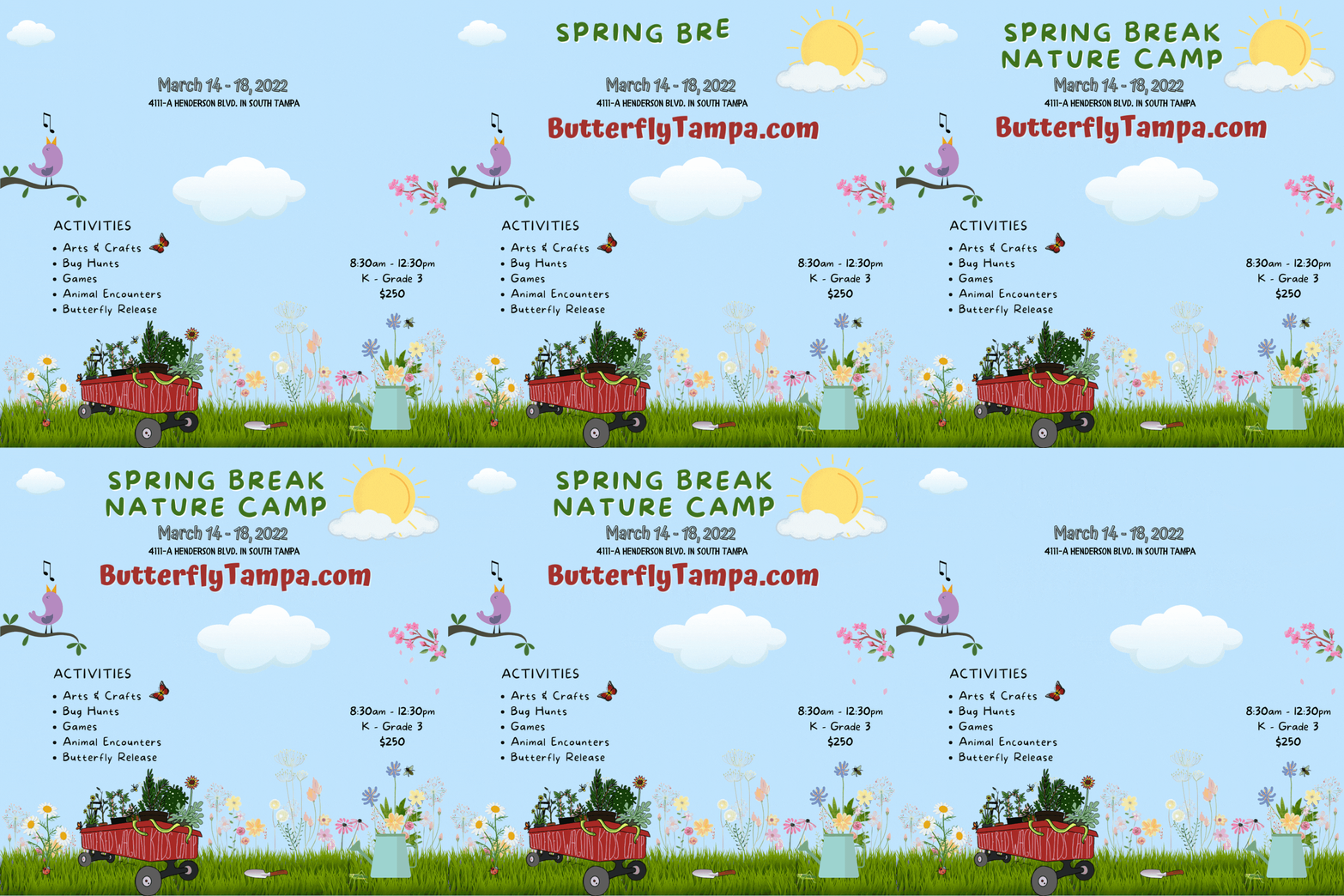
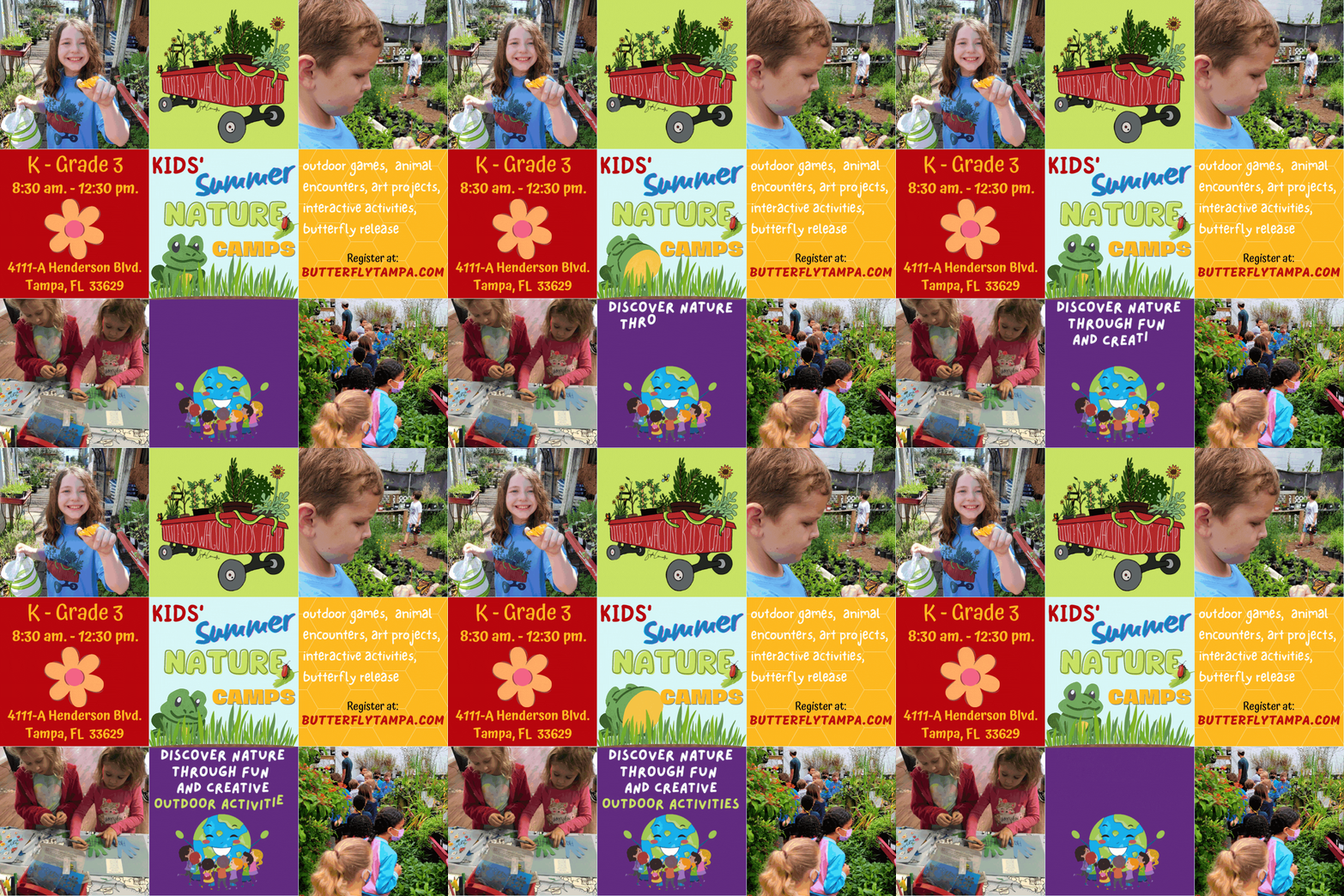
Registration is Open for Spring & Summer Camps Nature comes alive in the spring! It is a very exciting time of year for the plants, butterflies, wild bees and birds. Campers will discover nature and wildlife while learning to care for our environment. Every child will get an opportunity to release a butterfly by the end of the camp (weather permitting). Don't delay – space is limited!
Click to download a brochure with more details and to register. |
|
|
| | Before you know it, summer will be here. Register your child for our Summer Nature Camp program. Sessions begin May 31 and will run until August 9. Space is limited so register early! | |
|
|
UPCOMING VOLUNTEER OPPORTUNITIES:
CFC Butterfly Garden Maintenance: March 10 @ 9:00 am - 11:00 am
The Florida Aquarium, Tampa Bay Butterfly Foundation and FWC's Suncoast Youth Conservation Center are looking for volunteers to assist with habitat maintenance at Center for Conservation site of the Florida Conservation and Technology Center in Apollo Beach (529 Estuary Shore Lane) as well as their Adopt a Road site along Dickman Road.
To volunteer, click or copy and paste into a browser: https://volunteersignup.org/CC3HT
Spring Break Nature Camp Assistants: March 14-18 @ 8:00 am - 1:00 pm
Adult or High School volunteers are needed to assist with our nature camp for children in Kindergarten to Grade 3. We will have a planning meeting one week in advance of the camp (date and time TBD).
To volunteer, click or copy and paste into a browser: https://volunteersignup.org/9BYX4
Tampa GreenFest: March 26 & 27 @ 8:30 am - 4:30 pm
Volunteers are needed to assist. Will be held on the grounds of Tampa Garden Club at 2629 Bayshore Blvd.
To volunteer, click or copy and paste into a browser:https://volunteersignup.org/BLKFQ
Encore! Technology Park: March 29 @ 5:30 pm – 7:30 pm
Volunteers are needed to help maintain the Tampa Bay Butterfly Foundation-sponsored butterfly garden at Encore! Park located at 1210 E. Harrison St. (Corner of Harrison Street and Hank Ballard St.)
To volunteer, click or copy and paste into a browser: https://volunteersignup.org/KDJRP
TBBF Hell Strip Habitat Maintenance: March 31 @ 5:30 pm - 7:30 pm
Volunteers are needed to perform Hell Strip Habitat maintenance (4110 W. Estrella St.).
To volunteer, click or copy and paste into a browser: https://volunteersignup.org/YMA3A |
|
|
Little Red Wagon Native Nursery: We currently need garden enthusiasts to help us support the efforts of Tampa Bay Butterfly Foundation’s conservation, restoration, research, and education efforts. To join our awesome volunteer team, click or copy and paste into a browser: https://volunteersignup.org/9BQTJ |
|
|
|
ABOUT THE TAMPA BAY BUTTERFLY FOUNDATION: With a focus on Florida butterfly species and native plants, environmental education and local awareness in the Tampa Bay area, Tampa Bay Butterfly Foundation was established to support the conservation of butterflies and pollinators and the restoration of their natural wildlife habitats. By working globally with university research partners, providing educational and research opportunities and community outreach programs, and through multi-faceted fundraising efforts, the Foundation aims to elevate public awareness of the importance of butterflies.
The Tampa Bay Butterfly Foundation Inc., a 501(c)(3), is an affiliate of the Butterfly Conservatory of Tampa Bay. |
|
|
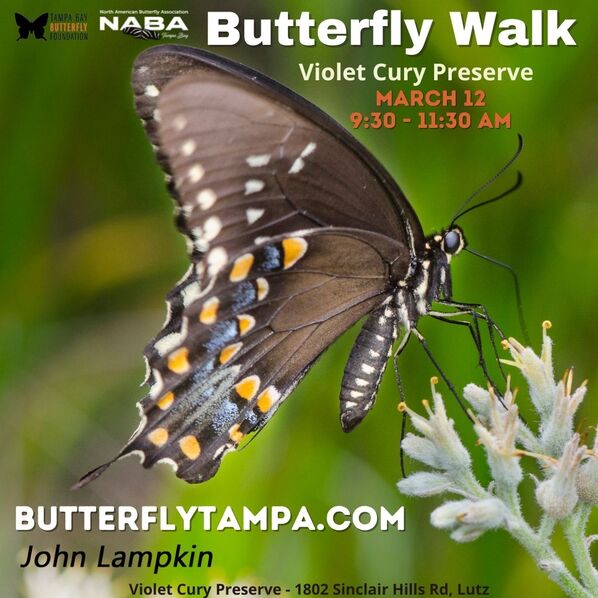
| | Join Tampa Bay Butterfly Foundation and NABA Tampa Bay on a butterfly walk to continue our monthly monitoring of butterfly species at Violet Cury Preserve in Lutz on Saturday, March 12 from 9:30 a.m. to 11:30 a.m. at 1802 Sinclair Hills Road. This will be free for NABA members; only $5 for non-NABA members. Please bring payment morning of event. | | |
|
|
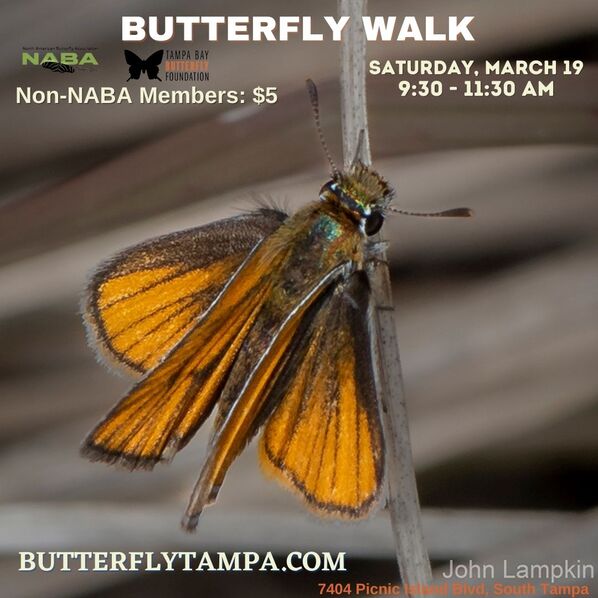
| | Join Tampa Bay Butterfly Foundation and NABA Tampa Bay on a butterfly walk to continue our monthly monitoring of butterfly species at Picnic Island in South Tampa on Saturday, March 19. We will start out at around the southern-most part of the park at 9:30 a.m. and work our way to the entrance by 11:30 a.m. Only $5 for non-NABA members. Please join us and bring payment morning of event. | | |
|
|
Visit our temporary butterfly education exhibit during Little Red Wagon Native Nursery’s normal business hours while the Butterfly Conservatory is being constructed. Enjoy live butterflies, their caterpillars and chrysalis as well as a few native reptiles Tuesdays through Sundays. While the education exhibit is currently free, we do accept donations for Tampa Bay Butterfly Foundation for education, research, habitat restoration and conservation for butterflies and native plants in our area. Please keep visiting
Butterfly Conservatory of Tampa Bay website for updates regarding our Grand Opening. For updates, visit: | |
|
|
|
March 1: Mardi Gras
March 3: World Wildlife Day - Plant a tree or a pollinator garden to support wildlife and our ecosystem.
March 8: International Women's Day
March 12: National Girl Scout Day, National Plant a Flower Day March 12: Butterfly Walk at Violet Cury Preserve March 13: Daylight Savings Begins March 14: Learn about Butterflies Day March 17: St. Patrick's Day, World Spider Day
March 18: Global Recycling Day March 19: National Backyard Day, Butterfly Walk at Picnic Island
- Join Us! March 20: World Sparrow Day, World Frog Day March 21: World Planting Day March 22: World Water Day March 28: National Weed Appreciation Day, Day of Insects March 30: Little Red Wagon Day - Stop by for a discount and surprise give away (while supplies last).
|
|
|
|
|
|